Booths China: The Story Behind a Stoke-on-Trent Treasure
Bold patterns, rich glazes, and a Stoke-on-Trent pedigree — discover why Booths china is one of vintage collecting's best-kept secrets, and how to start your own collection.
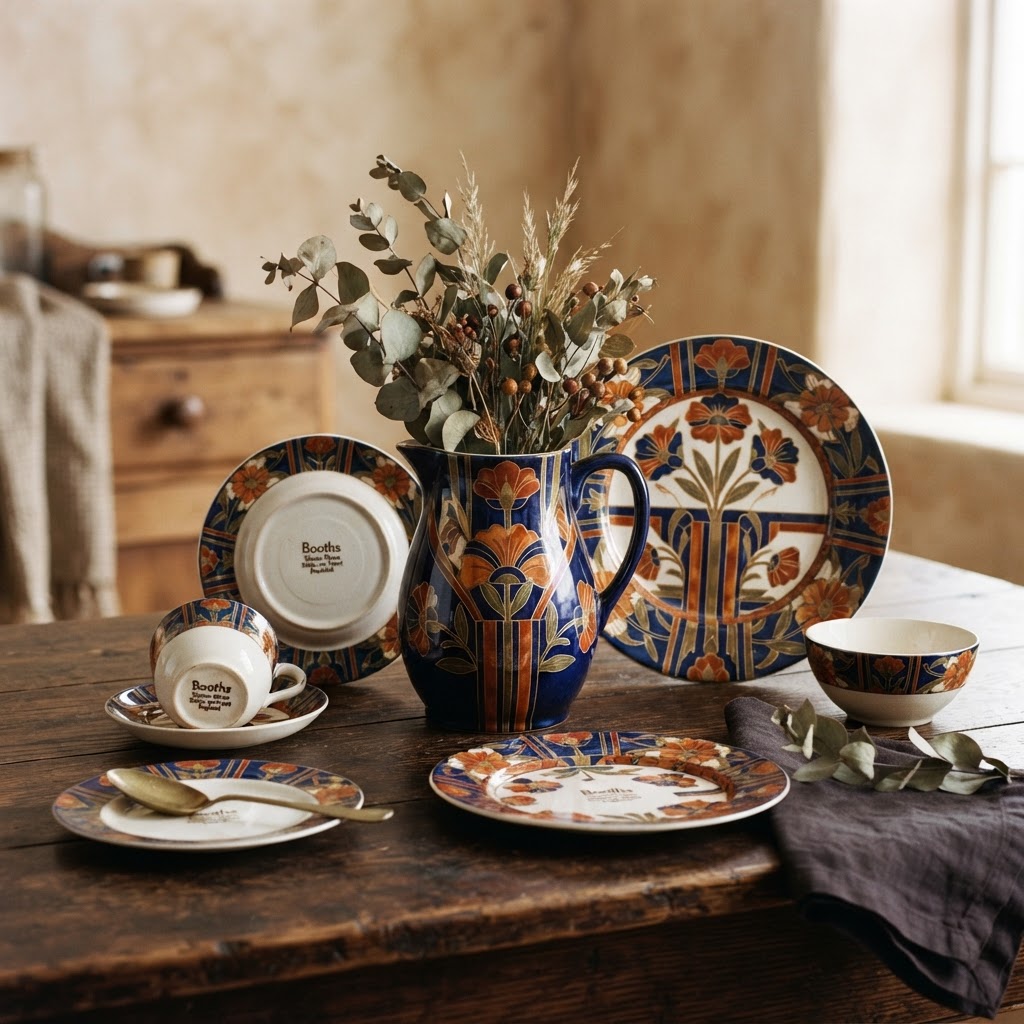
Booths China: The Story Behind a Stoke-on-Trent Treasure
When collectors think of Staffordshire pottery, the great names — Wedgwood, Spode, Minton — tend to dominate. But tucked among them is a quieter story: Booths. Bold, colourful, and beautifully made, Booths china is one of vintage collecting's best-kept secrets. For a fraction of the price of its more famous neighbours, it offers rich glazes, distinctive patterns, and a genuine Stoke-on-Trent pedigree.
This is the story of Booths china — where it came from, what to look for, and why it deserves a place in your collection.
A Short History of Booths Pottery
Booths pottery was established in 1864 by George Booth in Tunstall, one of the six towns that make up Stoke-on-Trent. The business began as a relatively modest earthenware manufacturer, producing practical wares for the domestic market. In 1891 the company was incorporated as Booths Ltd, and over the following decades it built a reputation for well-decorated, affordable china that sat comfortably between the utilitarian output of the larger potteries and the fine bone china of the luxury makers.
Like many Staffordshire firms, Booths weathered two world wars, changing tastes, and the steady decline of the British pottery industry through the late 20th century. Production eventually wound down, but vast quantities of Booths china survive in homes, attics, and the secondary market — which is precisely what makes it such a rewarding area to collect today.
The Booths Aesthetic
What sets Booths apart from its Staffordshire neighbours is a confident, slightly flamboyant style:
- Bold colours. Where many British potteries leaned towards restrained blues and whites, Booths embraced deep cobalt, burnt orange, forest green, and rich gold.
- Nature-inspired patterns. Birds, flowers, fruit, and scenic landscapes recur throughout the Booths catalogue.
- Art Deco influence. The interwar years saw Booths produce ranges with clean geometric borders and stylised motifs that sit comfortably alongside the best Art Deco ceramics.
- Practical shapes. Booths made china to be used — teapots, jugs, plates, and serving dishes that feel good in the hand as well as on the shelf.
Key Patterns to Look For
Real Old Willow
A Booths interpretation of the classic willow pattern, Real Old Willow is one of the most recognisable Booths designs. The familiar blue-and-white landscape is rendered with a softness that distinguishes it from earlier Chinese-inspired versions, and pieces turn up regularly at auctions and online marketplaces.
Sienna
The Sienna pattern, with its warm earthy ground and richly decorated borders, is a fine example of Booths' confident use of colour. Plates and serving pieces in this pattern make a striking display grouped together.
Lucerne
Lucerne features a softer, more floral aesthetic — delicate sprays of flowers on a pale ground. It's an excellent pattern for collectors who prefer the gentler side of Booths, and a full tea service is an achievable goal.
Art Deco Ranges
The interwar Art Deco ranges are where Booths really shines. Look for geometric borders, stylised florals, and bold banding in deep colours. These pieces are less common than the standard tableware patterns and are genuinely worth seeking out.
Why Collect Booths?
There are several reasons Booths makes a particularly satisfying collecting field:
- Affordable. Individual pieces often cost a fraction of comparable Wedgwood or Royal Doulton, making it easy to build a meaningful collection without a large budget.
- Accessible. Booths china is common in the secondary market — charity shops, auctions, and online — so the hunt is realistic, not frustrating.
- Useable. Booths was made for the table, and most pieces are robust enough to be used, not just displayed.
- Underappreciated. Because it flies below the radar of many collectors, the best pieces can still be found at modest prices — a situation unlikely to last.
Identifying Booths China
Booths pieces are usually straightforward to identify, but it pays to know what to look for:
- Backstamps. Most Booths pieces carry a printed or impressed mark, often including the word "Booths," the pattern name, and "Made in England." Familiarising yourself with the main backstamp styles is the first step.
- Pattern numbers. Many pieces carry a pattern number alongside the backstamp, useful for matching items to a specific range.
- Quality of decoration. Genuine Booths china is well-printed and evenly glazed; the decoration should be crisp, with no blurred edges or smeared colour.
- Shape. Booths shapes have a certain solidity — jugs with confident handles, teapots with well-proportioned spouts. Handling a few genuine pieces trains the eye quickly.
Caring for Booths China
Booths china is robust, but a little care extends its life and keeps it looking its best:
- Hand-wash where possible. Dishwashers can dull printed decoration and gold edges over time.
- Avoid sudden temperature changes. Don't pour boiling water into a cold jug.
- Stack carefully. Place a layer of tissue or felt between stacked plates to protect printed rims.
- Display thoughtfully. Grouped by colour or pattern, Booths pieces make a vivid display; mixed at random, they can look busy.
The Staffordshire Pottery Story
To collect Booths is to collect a piece of Staffordshire itself. For more than three centuries, the six towns of Stoke-on-Trent — Tunstall, Burslem, Hanley, Stoke, Fenton, and Longton — formed the most important ceramics-producing region in the world. Each town specialised in different wares, and Booths' Tunstall home placed it firmly in the tradition of well-made, characterful earthenware for the British home.
That tradition is largely gone now, but the pots remain — and collecting them is one of the best ways to keep the story alive.
Starting Your Booths Collection
The easiest way to begin is with a single piece you genuinely like — a plate, a jug, or a teacup — in a pattern that catches your eye. Live with it, use it, and learn the backstamp. From there, a full tea service in Lucerne or a wall of Art Deco plates is a realistic and deeply satisfying ambition.
Searching for a particular Booths pattern? Browse our current vintage stock — or get in touch and we'll help you track it down.