Buying Retro and Vintage Tableware: A Practical Guide
From Denby stoneware to Susie Cooper, Hornsea and Kilncraft — a practical, jargon-free guide to buying, dating, assessing and caring for retro and vintage British tableware.
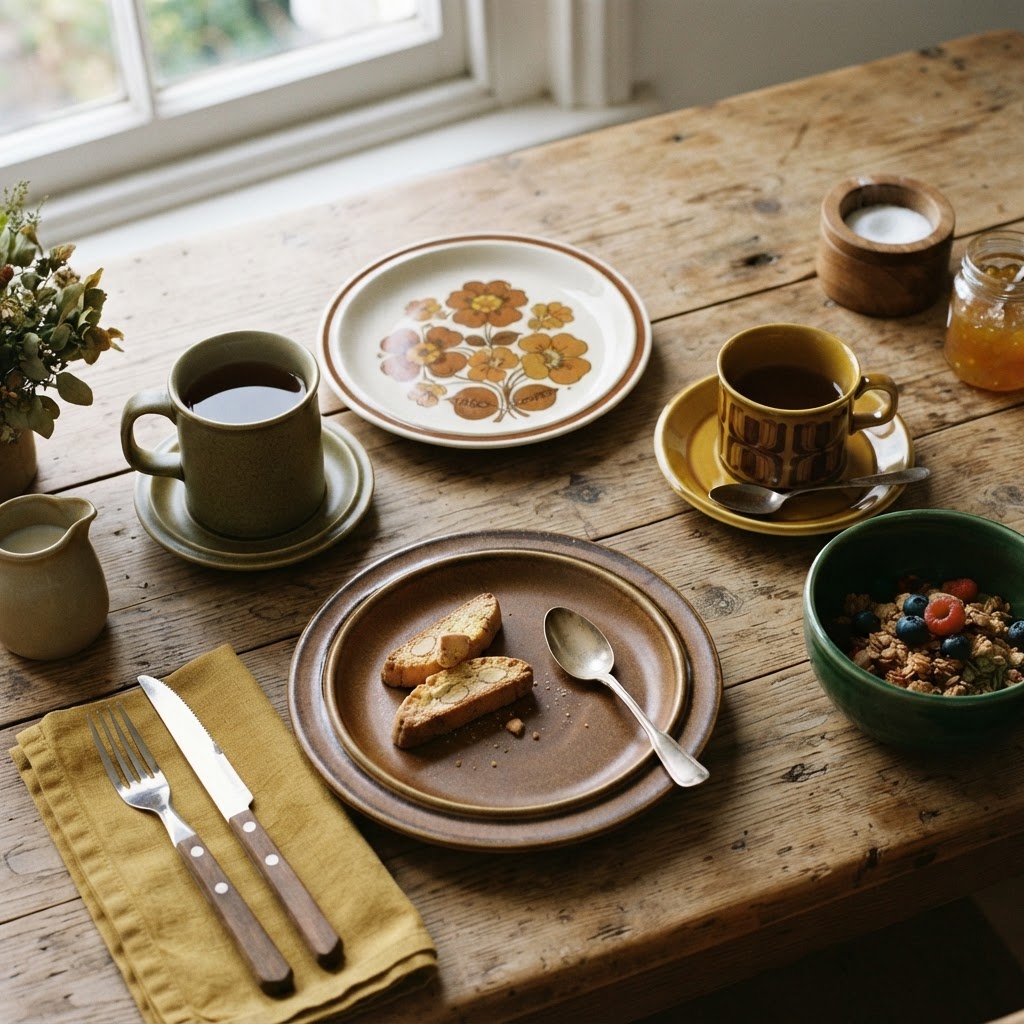
Buying Retro and Vintage Tableware: A Practical Guide
There is a particular kind of satisfaction that comes from eating breakfast off a plate that was made fifty years before you were born. It is not just nostalgia — it is the quiet pleasure of well-made objects, of patterns that have outlived their makers, and of a table that looks like it belongs to someone rather than to a catalogue. Retro and vintage tableware brings character, craftsmanship and a story to every meal.
But buying vintage ceramics for the first time can feel daunting. How do you tell a genuine 1960s piece from a modern reproduction? What is actually worth paying for? Where do you even look? This guide walks through everything you need to know to start buying retro and vintage tableware with confidence.
Retro vs Vintage: What Is the Difference?
The two words are often used interchangeably, but they mean different things, and it helps to know which you are after:
- Vintage generally refers to tableware that is genuinely old — typically forty to one hundred years old. A 1930s Susie Cooper tea cup or a 1950s Midwinter plate is vintage.
- Retro refers to pieces that capture the look of an earlier era. A piece can be retro without being old — a newly made plate in a 1970s style is retro but not vintage.
Both have their place. Genuine vintage brings history and provenance; retro lets you achieve a period look without the hunt (or the price tag). Many of the best-dressed tables blend the two.
Why Buy Vintage Tableware?
Before we get to the how, it is worth being clear on the why. Vintage tableware offers things that new tableware, almost without exception, cannot:
- Design that has stood the test of time. The pieces still sought after decades on were the best of their era. The faddish and the poorly made have fallen away.
- Character and individuality. No two vintage tables look the same. Your collection is a reflection of your own taste, not a showroom display.
- Craftsmanship. Much mid-century British pottery was made by hand in Stoke-on-Trent, with a level of finish that is rare at today's price points.
- Sustainability. Buying vintage is the ultimate form of recycling — no new energy or materials go into making a piece that already exists.
- Affordability. Surprisingly often, vintage tableware costs less than a new equivalent of comparable quality.
The British Brands Worth Knowing
British pottery has a rich heritage, and a handful of names dominate the vintage tableware market. Knowing them gives you a framework for what to look for:
Denby
Denby stoneware, made in Derbyshire, is prized for its toughness and its distinctive earthy glazes. The 1960s and 1970s ranges designed by Gill Pemberton — particularly Chevron and Arabesque — are highly sought after, but even unnamed Denby pieces are a reliable buy thanks to their robustness.
Susie Cooper
Susie Cooper was a pioneer of modernist British ceramics, designing clean, functional tableware from the 1920s onward. Her Art Deco patterns such as Curlew and Kestrel are collectable, yet her work remains more affordable than that of her famous contemporary, Clarice Cliff.
Midwinter
Midwinter Pottery, active through the 1950s and 1960s, produced some of the most stylish mid-century tableware in Britain. The Stylecraft range, with its modern shapes and bold patterns, captures the optimism of post-war British design.
Hornsea
Hornsea Pottery of Yorkshire is beloved for its 1970s ranges — Heirloom, Saffron, and Bronte — characterised by their distinctive earthy patterns and robust earthenware bodies. A Hornsea mug is one of the great joys of a 1970s kitchen.
Kilncraft
Launched by Staffordshire Potteries in 1972, Kilncraft brought affordable, boldly patterned tableware to millions of British households. The Bacchus grapevine pattern is its most iconic design and a wonderful entry point for new collectors.
J&G Meakin and Johnson Brothers
These names turn up constantly in vintage tableware. Both produced enormous quantities of transfer-printed tableware for the British home, much of it in attractive mid-century patterns that remain inexpensive today.
Where to Buy Vintage Tableware
One of the great pleasures of collecting vintage tableware is the hunt itself. There are several good sources, each with its own character:
- Charity shops and car boot sales. The most affordable source, and the most unpredictable. You will see a lot of ordinary ware, but genuine finds still turn up regularly.
- Antique centres and vintage fairs. A step up in price, but a reliable place to find named pieces in good condition. Dealers can often tell you the history of what they are selling.
- Online marketplaces. eBay, Etsy and dedicated vintage sites offer enormous selection, but you cannot handle the piece before buying — so condition checks matter even more.
- Specialist dealers. For specific patterns or makers, a specialist dealer is the fastest route. Prices are higher, but so is the likelihood of finding exactly what you want.
- Auctions. House clearance auctions can yield whole tea services at remarkable prices, though you are often buying a job lot rather than a single piece.
How to Assess Condition
Condition is the single most important factor in vintage tableware, and it is where new buyers most often come unstuck. Here is what to check before you buy:
- Run a finger around the rim. A chip that is invisible to the eye is often detectable by touch. Small nibbles to the rim are common and acceptable on inexpensive pieces, but they reduce value.
- Check for cracks by tapping. Hold the piece loosely and tap it lightly with a fingernail or a pencil. A clear ring means it is sound; a dull thud suggests a crack, even one you cannot see.
- Look for crazing. Crazing is the network of fine cracks that appears in the glaze over time. It does not always weaken a piece, but it is a sign of age and affects value. It also makes the piece more prone to staining.
- Inspect the glaze for staining. Tea and coffee stain crazed glazes over the years, leaving brownish marks particularly inside cups. Sometimes these can be cleaned; sometimes they cannot.
- Examine the underside. The backstamp tells you the maker and often the era, and the foot rim shows how much the piece has been used. Heavy knife marks on the foot suggest a well-loved, well-used piece.
- Look for restoration. A hairline crack may have been invisibly repaired. Look for slight discolouration or a ridge along the repair line. Professionally restored pieces are fine for display but worth less than untouched originals.
How to Date a Piece
Dating vintage tableware is part knowledge, part detective work. A few reliable clues help:
- The backstamp. Most British potteries changed their marks over the years. A reference book or a quick online search of the mark will often narrow a piece to within a decade.
- Pattern registration numbers. Some marks include a registration number ("Rd No.") that can be looked up to find the date a pattern was registered.
- The style itself. Art Deco geometry points to the 1930s; the clean modernism of the Festival of Britain era points to the 1950s; bold earthy patterns point to the 1970s.
- The shape. Handles, foot rims and plate profiles all evolved with fashion. With experience you will start to recognise an era by shape alone.
How to Spot a Reproduction
Reproductions are not inherently bad — a new piece in a vintage style can be a perfectly good buy — but you should know what you are paying for. A few warning signs suggest a piece may not be as old as it appears:
- A brand-new looking glaze. Genuine vintage almost always shows some sign of age, however slight.
- A modern backstamp. Compare it to verified marks online. Modern reproductions sometimes carry marks that look right but include subtle differences.
- A price that seems too good. A pristine Clarice Cliff plate for a tenner is almost certainly not the real thing.
- Perfect uniformity. Hand-made vintage pieces vary slightly; identical, flawless pieces suggest modern mass production.
When in doubt, buy from reputable dealers who can vouch for authenticity, and be prepared to walk away from a deal that feels off.
Building a Collection
The most satisfying collections are built with a little thought rather than grabbed at random. A few approaches work well:
- Collect one maker. Focusing on, say, Hornsea or Susie Cooper lets you learn the range deeply and spot bargains others miss.
- Collect one pattern. Tracking down every piece of a single discontinued pattern is a rewarding long-term project.
- Collect one era. A table dressed entirely in 1950s Midwinter has a coherence that a random assortment never will.
- Collect one colour. Building around a single palette — earthy browns, say, or cool blues — lets you mix makers while keeping a unified look.
- Collect eclectically. There is nothing wrong with buying what you love, piece by piece. An eclectic table, dressed with care, has a warmth all of its own.
How Much Should You Pay?
Vintage tableware prices vary enormously, but as a rough guide for ordinary British pieces in good condition:
- Common plates and cups from well-known makers can be found for a few pounds each.
- Named patterns in good condition typically fetch £8 to £25 per piece, depending on rarity and desirability.
- Sought-after designer pieces — a Denby Chevron bowl, a Susie Cooper Curlew plate — can reach £30 to £80 or more.
- Rare or iconic pieces from celebrated designers or patterns command the highest prices and are best bought through specialist dealers.
The best advice is simply to buy the best condition you can afford, and to pay a little more for a piece you genuinely love.
Caring for Vintage Tableware
Vintage tableware was made to be used, and most of it will give decades more service with a little care:
- Hand-wash where possible. Dishwashers are harsh on older glazes and transfer prints, accelerating wear and fading.
- Avoid sudden temperature changes. Plunging a cold cup into hot water can crack it. Warm pieces gradually.
- Stack carefully. Place a soft cloth or felt divider between stacked plates to prevent scratching and chipping of the rims.
- Watch for lead glazes. Some very old or brightly coloured pieces may use lead glazes. These are fine for display; for everyday food use, stick to mainstream 20th-century tableware from reputable makers.
- Clean stains gently. Bicarbonate of soda paste or a mild denture cleaner can lift tea stains from crazed glazes without damaging the piece.
Bringing It Home
Buying retro and vintage tableware is not really about acquiring objects. It is about surrounding yourself with things that have lived a life before they reached you — pieces that carry the marks and memories of other tables, other meals, other hands. Start with a single piece that catches your eye, learn as you go, and before long you will have a table that tells a story no shop-bought set ever could.
Browse our collection of retro and vintage tableware and start your own collection today.