Kilncraft Tableware: The 1970s Staffordshire Success Story
Launched in 1972 by Staffordshire Potteries Ltd, Kilncraft brought bold modern patterns and earthy 1970s style to British kitchens everywhere. Discover the story behind the brand, its iconic Bacchus pattern, and how to start collecting today.
Kilncraft Tableware: The 1970s Staffordshire Success Story
Open the kitchen cupboard of almost any British household in the mid-1970s and there was a fair chance you would find it: earthy brown dinner plates patterned with stylised grapevines, matching cups with their distinctive curved handles, and a sugar bowl that somehow always seemed to be chipped on the rim. The backstamp read Kilncraft, and for a brief, brilliant decade it was one of the most recognisable names on the British table.
Kilncraft was never fine china. It was never meant to be. It was honest, affordable, machine-made tableware for ordinary families — and that is precisely why it deserves a second look today. The patterns couldn't be more 1970s, the forms are unapologetically modern, and the story behind the brand is a fascinating window into a Staffordshire pottery industry fighting to reinvent itself.
This is the story of Kilncraft — and a practical guide to collecting it.
The Origins: Staffordshire Potteries Ltd
Kilncraft was the creation of Staffordshire Potteries Ltd, a company that grew out of the Keele Street Pottery Group. In the 1950s, the firm was a producer of utilitarian white cups and plain dinner wares — competent, hardworking pottery, but nothing that would turn a head. Through the 1960s it increasingly concentrated on the production of mugs, a humble but high-volume product that would later become central to the company's fortunes.
By the early 1970s, the British tableware market was shifting. The fussy florals and chintzy reproduction patterns of the post-war years were losing ground to a new appetite for clean, modern design. Staffordshire Potteries saw the opportunity and, in 1972, launched a brand-new range with a brand-new name: Kilncraft.
The Kilncraft Revolution (1972)
The Kilncraft brand name was introduced in 1972 and brought with it a new range of modern shapes, colours and surface decorations. This was not a timid relabel — it was a wholesale reinvention. The shapes were contemporary, the decoration was applied by transfer in bold, confident patterns, and the price point put it within reach of the ordinary household.
The launch was a runaway success. So much so that the Kilncraft name and trademark were adopted as the corporate symbol for Staffordshire Potteries Ltd itself — the brand had outgrown the company that created it. For the next decade, Kilncraft would be the face of the firm.
The Iconic Kilncraft Logo
It is worth pausing on the logo, because it is one of the most iconic pieces of British graphic design of the 1970s. The wordmark splits across two lines — "KILN" above "CRAFT" — which is why the brand is so commonly referred to as "Kiln Craft." It is bold, geometric, and unmistakably of its era. For collectors, the logo is part of the appeal: it is a piece of 1970s design history printed onto the underside of every plate.
The Patterns: Bacchus, Hermes, Midas and More
The Kilncraft catalogue was broad. Three of the earliest and most significant sets were named after figures from Greek mythology — Bacchus, Hermes, and Midas — and Bacchus in particular would become the pattern that defined the brand.
Beyond the mythologically named trio, the range expanded to include a host of other patterns. Among the most recognisable are:
- Bacchus — the grapevine pattern, by far the most successful of all Kilncraft designs
- Bramble — a bramble-and-berry motif in earthy tones
- Amberstone — a warm amber design listed in the Argos catalogue of 1978
- Nova — a strikingly modern abstract range sold as boxed sets
- Festival — produced in brown, green, and pink colourways
- Martinique and Salisbury — both listed in early-1980s Argos catalogues
- Indigo, Biarritz, Canterbury, and Wild Berries — a sampling of the many transfer-printed designs that followed
Many Kilncraft patterns were never given a name on the backstamp or on the boxes they were supplied in, which makes identification a pleasing challenge for the dedicated collector. Side plates frequently carried a slightly different variation of the same pattern as the dinner plates — a detail that rewards close looking.
Bacchus: The Pattern That Defined a Decade
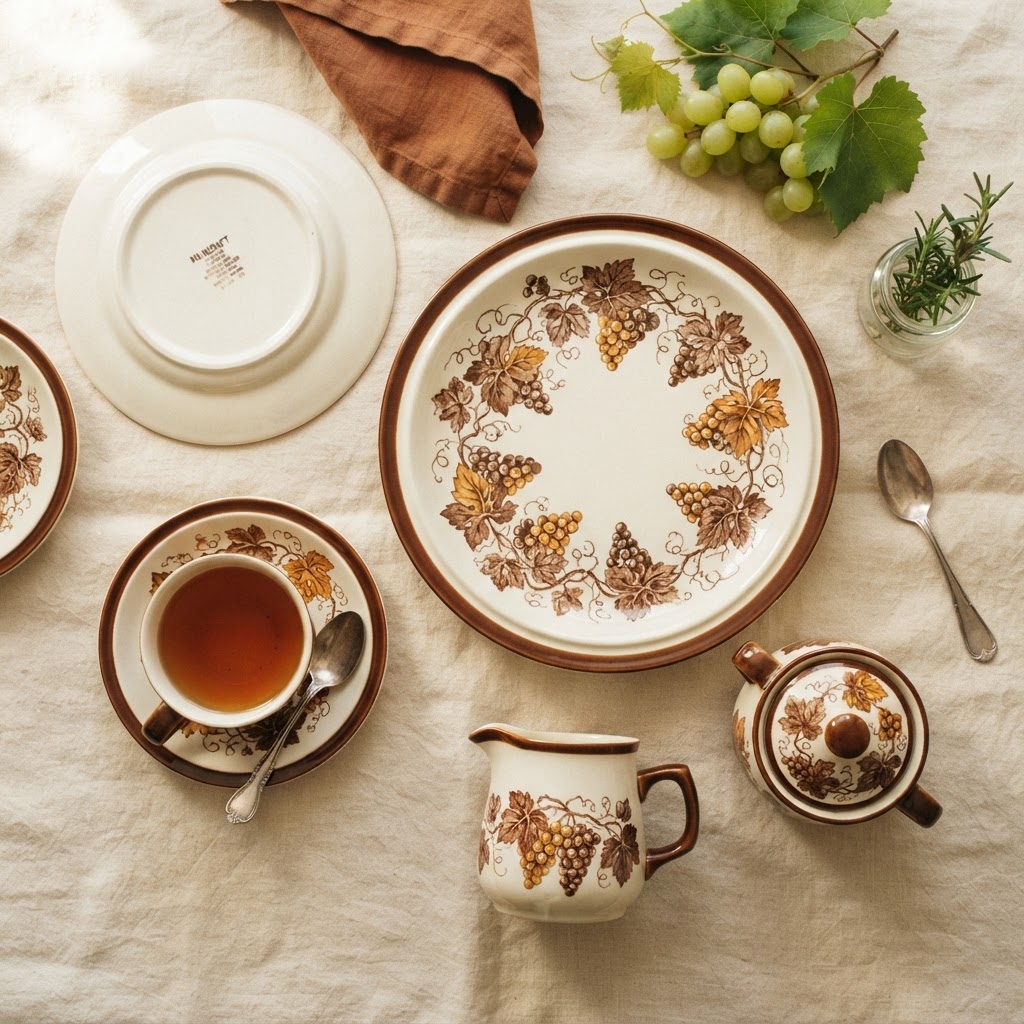
Of all the Kilncraft patterns, Bacchus is the one that endures in the memory. Its stylised grapevines and leaves, rendered in earthy brown transfer print, are the very image of 1970s British domestic life. It was huge — sold as utilitarian, affordable kitchenware, and produced in enormous quantities.
Bacchus was not the most durable pottery ever to come out of Stoke-on-Trent. The ware is somewhat softer than the output of rival firms, which is why pristine pieces are harder to find than you might expect given the volumes produced. But what it lacks in toughness it makes up for in character. The pattern is so unmistakably of its decade that a single Bacchus plate on a kitchen shelf is enough to transport a room back to 1976.
There are at least three known colour variations of Bacchus, including a rarer brown variation, and serious collectors enjoy tracking them down.
The 1980s: Mugs and Pastels
The story of Kilncraft takes a turn in the 1980s. In 1979, Staffordshire Potteries acquired the prestigious Royal Winton brand and launched a new range of red stoneware "cook and serve" dinner wares and cookwares, specially designed for the new wonder of the modern kitchen — the microwave oven. It was a forward-looking move.
But by 1983, this rustic stoneware range had been abandoned in favour of the delicate pastel colours of the eighties. The market had moved on, and Kilncraft moved with it. Increasingly, the brand was used for drinking mugs, produced with literally hundreds of different transfer patterns. By 1985, Staffordshire Potteries were the largest manufacturers of mugs in the world, producing over 750,000 mugs every week — an astonishing figure that speaks to the sheer scale of the operation.
The Coloroll Years and the End
The late 1980s brought upheaval. In 1986, Staffordshire Potteries was taken over by the Coloroll home furnishings group of Manchester. A management buyout followed in 1990, and the company was renamed Staffordshire Tableware. But the reinvention did not hold — the firm failed a few years later, and with it the Kilncraft name largely faded from production.
It is worth noting, for the careful collector, that there was also a separate Hong Kong manufacturer called Kilncraft, established in 1980, which produced ceramics including some similar plates. The two are not connected, and the Hong Kong ware is generally less sought after than the original Staffordshire output.
Why Collect Kilncraft Today
Kilncraft occupies a pleasing sweet spot for collectors of retro and vintage homeware:
- Genuinely affordable. Unlike Clarice Cliff or Susie Cooper, Kilncraft can still be found at car-boot-sale prices. A set of Bacchus plates need not break the bank.
- Unmistakably 1970s. If you want to capture the look and feel of a British 1970s kitchen, nothing does it more authentically.
- The graphic design. The logo alone is a piece of design history, and the transfer patterns are a study in 1970s commercial graphics.
- Build a set gradually. Because Kilncraft was produced in such volume, it is realistic to assemble a full matching set over time — a satisfying project.
- Everyday useability. Kilncraft was made to be used, and while the ware is not the toughest, handled with care it can still serve a Sunday lunch.
How to Identify Kilncraft
Identifying genuine Staffordshire Kilncraft is straightforward once you know what to look for:
- The backstamp. Look for the distinctive split "KILN / CRAFT" wordmark on the underside. It is one of the most recognisable marks in British pottery.
- "Staffordshire Potteries Ltd" and "Made in England." The full backstamp typically includes the manufacturer name and country of origin.
- Pattern names. Some pieces carry the pattern name — Bacchus, Bramble, Nova — but many do not, so do not assume an unmarked piece is not Kilncraft.
- Beware the Hong Kong ware. A separate Kilncraft was established in Hong Kong in 1980. Check the backstamp carefully for the Staffordshire Potteries mark to confirm British origin.
Tips for Collecting
- Condition matters most. Because Kilncraft ware is relatively soft, chips and crazing are common. Hold out for clean examples where you can.
- Start with Bacchus. It is the most iconic pattern and the easiest to build a set around, thanks to the volumes produced.
- Collect by pattern or by colourway. Some collectors focus on a single pattern across every shape; others chase the rarer colour variations.
- Hunt the boxed sets. Kilncraft was sold in boxed tea and coffee sets, and a surviving original box adds both charm and value.
- Mix and match with confidence. Kilncraft's earthy palette plays well with other 1970s Staffordshire ware, so do not be afraid to blend patterns on a dressed table.
Caring for Kilncraft
Kilncraft was made for daily use, but it is vintage pottery now and deserves a little care. Avoid sudden temperature changes, which can cause crazing or cracking. Hand-washing is gentler than a dishwasher, particularly for pieces with transfer decoration that has already begun to wear. Stack plates with a soft divider to prevent the scratching that comes from ceramic rubbing on ceramic. Stored sensibly and used with a little thought, a Kilncraft set will give decades more service — which is, after all, exactly what it was made for.
A Place on the Table
Kilncraft will never be rare, nor will it ever command the prices of the great names of British ceramics. But that is not the point. It is honest, characterful, and gloriously of its time — the taste of a 1970s British kitchen pressed into clay and transfer print. For the collector who values story and style over investment, there are few more satisfying fields to explore.
Browse our selection of vintage Kilncraft and other retro Staffordshire tableware, and bring a piece of the 1970s back to your table.