Royal Worcester: A Collector's Guide to Vintage British Porcelain
From the year-cipher backstamps to the sought-after bird paintings of Charles Baldwyn — discover what makes vintage Royal Worcester porcelain so collectable, and how to start your own collection.
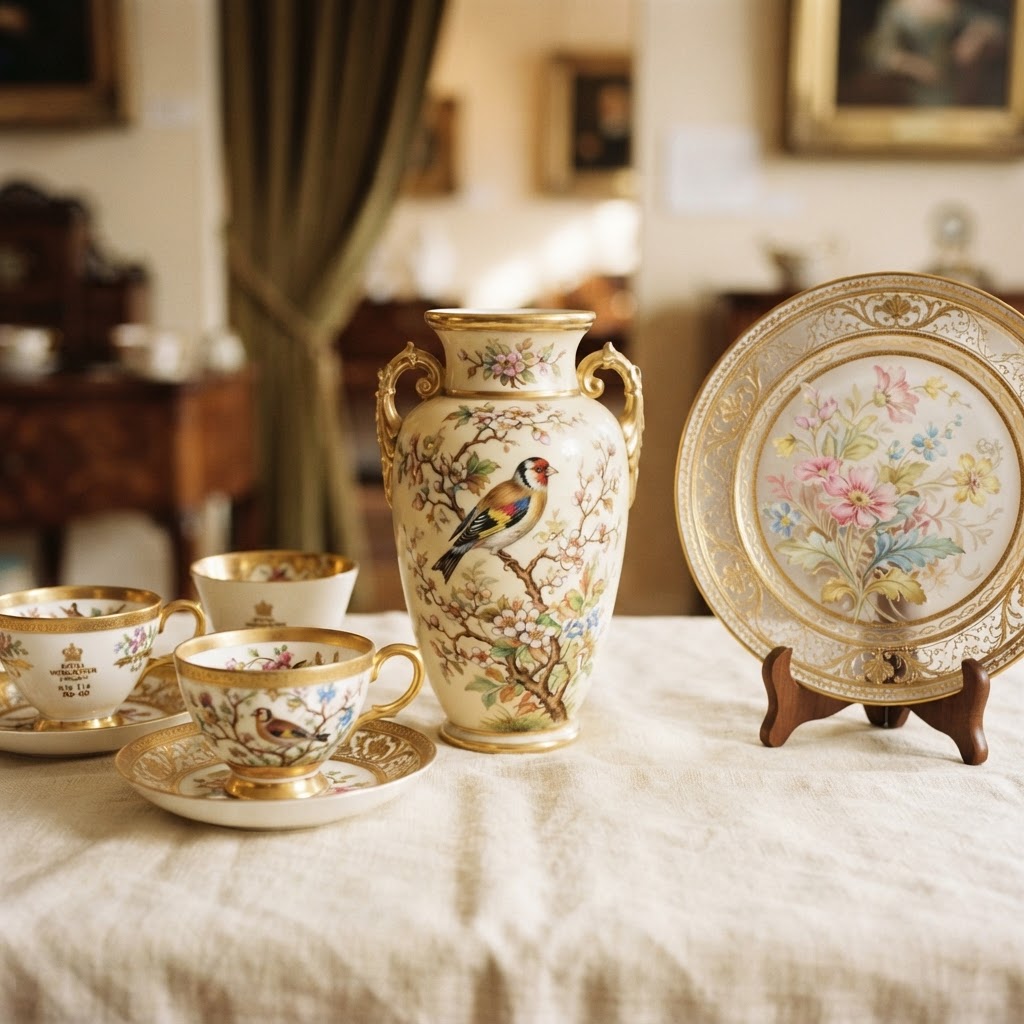
Royal Worcester: A Collector's Guide to Vintage British Porcelain
Few names in British ceramics carry the quiet authority of Royal Worcester. For more than 270 years, the factory's workshops have turned out pieces of astonishing translucency, hand-painted decoration, and technical innovation — from delicate tea wares to spectacular bird studies. For the collector, vintage Royal Worcester offers a rare combination of beauty, craftsmanship, and a dating system so precise you can often tell the year a piece was painted to the month.
Whether you're drawn to the softly painted fruit of the Evesham pattern or the dramatic flights of pheasants by Charles Baldwyn, this guide will walk you through the history, the key collections to look for, and how to start — and care for — your own Royal Worcester collection.
A Short History of Royal Worcester
Royal Worcester traces its origins to 1751, when Dr John Wall and a group of local investors established the Worcester Tonquin Manufactory on the banks of the River Severn. The young factory benefited from the technical knowledge of Bristol porcelain makers, and within a few years its wares were prized for their resistance to hot water — a rare quality in an age when most porcelain cracked at the first cup of tea.
Over the following century the company grew steadily, receiving a royal warrant and establishing the name "Royal Worcester" in the public imagination. The factory's golden age of collectable pieces, however, belongs largely to the late 19th and early 20th centuries — a period that produced the hand-painted bird studies, fruit paintings, and landscape scenes that collectors prize today.
What Makes Royal Worcester Special
Several qualities set Royal Worcester apart from other British porcelain manufacturers:
- Translucency — held to the light, fine Worcester bone china glows with a soft, warm translucency that mass-produced porcelain cannot match.
- Hand-painted decoration — the factory employed a roster of specialist painters, each signed or marked, whose work is recognisable to experienced collectors.
- Year ciphers — from 1868 onwards, almost every piece carries a small symbol representing the year it was decorated, allowing remarkably precise dating.
- Royal warrant — the continued patronage of the royal household speaks to the consistent quality of the factory's output.
- Range — from everyday tea wares to one-off exhibition pieces, there is a price point for almost every collector.
Key Collections to Look For
Evesham (1961)
Introduced in 1961 and named after the Vale of Evesham, the Evesham pattern is perhaps the most accessible entry point for new collectors. Designed by Professor Robert Baker, it features softly painted fruit and leaves — apples, pears, blackberries — on a pale ground, often with a fine gilt rim. Evesham was produced in enormous quantities, so individual pieces remain affordable, while a full service can become a lifelong pursuit.
Lavinia
The Lavinia pattern, with its delicate pink roses and green foliage on a white ground, represents the gentler, floral side of Royal Worcester's output. Plates, cups, and saucers in this pattern are relatively common at auction and online, making them ideal for building a coordinated display.
Flights and Pheasants by Charles Baldwyn
Charles Baldwyn was one of the factory's most celebrated bird painters, active in the late 19th century. His "flights of birds" — swallows, falcons, and pheasants in motion — are painted with extraordinary skill against softly tinted grounds. These pieces are rare and command significant prices, but even a single Baldwyn-signed plate is a genuine trophy for a serious collection.
Highland Cattle by the Stinton Family
The Stinton family — James Stinton and his son Harry — painted Highland cattle scenes on Worcester porcelain for decades. The subject matter, set against muted landscape backgrounds, has a distinctly romantic Victorian flavour. Stinton pieces are signed and dated, making them satisfying to collect with confidence.
How to Date Royal Worcester Using Year Ciphers
The year cipher system is one of the great pleasures of collecting Royal Worcester. From 1868, a small symbol — a dot, a cross, a symbol, or a letter — was added to the standard mark to indicate the year of decoration. A reference chart of these ciphers is essential; many are reproduced in ceramic reference books and online.
To date a piece:
- Look for the standard Royal Worcester mark — usually a circle containing the words "Royal Worcester" and a number.
- Find the small cipher or symbol added to the mark — often near the crown or beneath the word "England."
- Compare the cipher to a published year-cipher chart.
- Note any artist's signature or painted initials, which can help confirm the date.
A correctly read cipher will tell you not just the decade but the exact year — and sometimes the approximate month — a piece was decorated.
Tips for Collecting
- Start with what you love. Royal Worcester covers an enormous range; collecting around a single pattern, painter, or subject will keep your collection focused and rewarding.
- Learn the ciphers. A small reference chart, kept near your buying desk, is the single most useful tool you can own.
- Buy the best condition you can afford. Hairline cracks, chips, and restoration all reduce value; a perfect small piece is usually a better buy than a damaged large one.
- Look for signed work. Pieces carrying the signature of a named artist — Baldwyn, Stinton, or any of the fruit and flower painters — are more desirable and hold their value.
- Buy from reputable dealers. Reproductions and married pieces (genuine mark on a later body) exist; an experienced seller is your best safeguard.
- Consider display. Royal Worcester rewards being seen — a glass-fronted cabinet with soft lighting will show off translucency and gilding beautifully.
Caring for Vintage Royal Worcester
Royal Worcester is surprisingly robust, but a few habits will keep your collection at its best:
- Hand-wash only. Dishwashers, harsh detergents, and sudden temperature changes are the enemy of bone china and gilt decoration.
- Avoid stacking with metal. Place felt or acid-free tissue between stacked plates to prevent scratching of gilding and painted surfaces.
- Display out of direct sunlight. Prolonged exposure can fade hand-painted colours over many years.
- Handle with care. Lift cups by the body rather than the handle, which is the most fragile point on any teacup.
- Insure properly. A valuation from a qualified ceramics specialist will ensure your collection is covered for its true replacement cost.
Where to Start Your Collection
The easiest way to begin is with a single Evesham or Lavinia piece — a teacup and saucer, a side plate, or a small dish. These are widely available, reasonably priced, and give you a chance to handle the porcelain, learn the marks, and decide whether Royal Worcester is a passion you want to pursue. From there, the path is yours: a single pattern built into a full service, a collection of signed bird studies, or a cabinet of fruit-painted showpieces.
If you have a piece you'd like identified, or you're searching for a particular pattern, we're always happy to help — get in touch or browse our current stock of vintage homewares.

