Susie Cooper: The Pioneer of Modern British Ceramics
From her first studio in 1922 to becoming one of the most influential ceramic designers of the 20th century — discover why Susie Cooper's work remains as fresh today as it was a century ago.
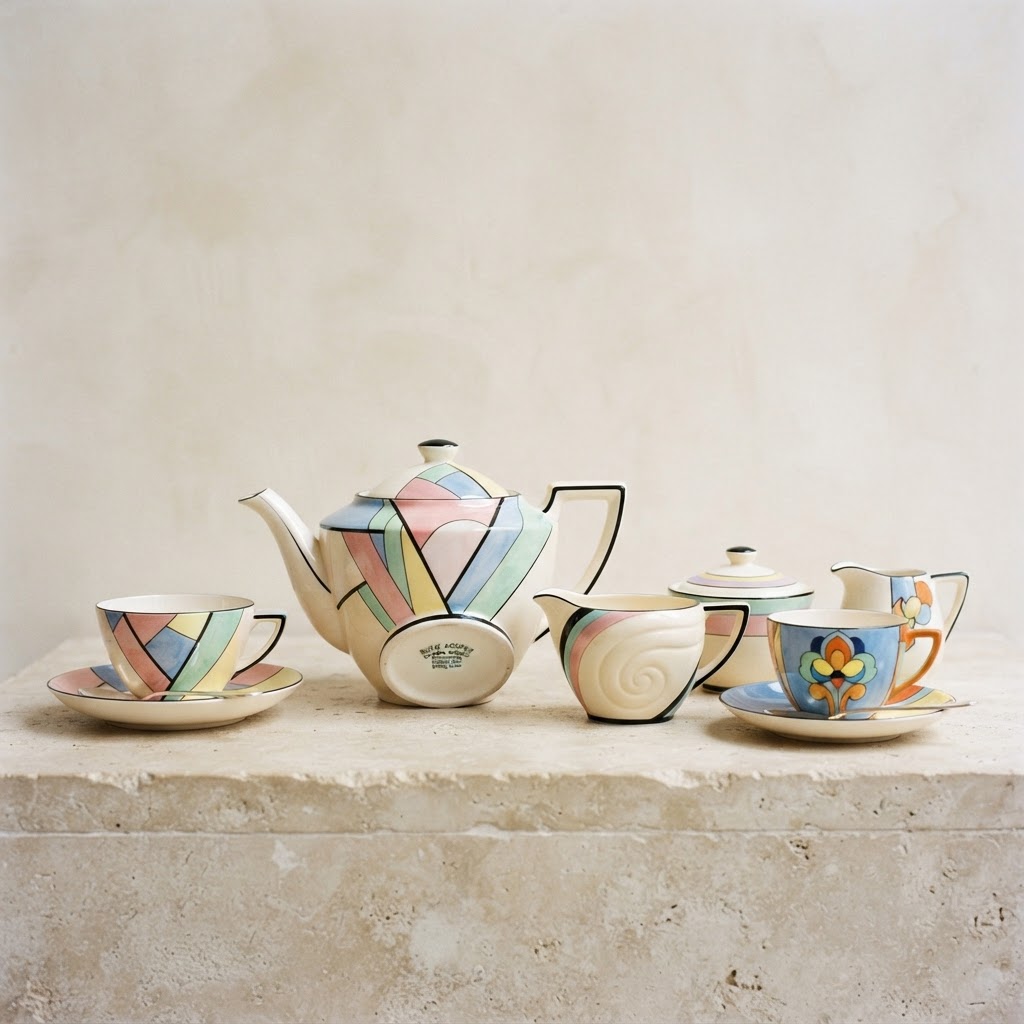
Susie Cooper: The Pioneer of Modern British Ceramics
Walk through any modern design shop today and you'll see the clean lines, the confident patterns, the pieces that are meant to be used as well as admired. That modern sensibility — ceramic design that belongs on the breakfast table, not behind glass — has a origin point, and its name is Susie Cooper.
For more than six decades, Susie Cooper shaped the way Britain thought about domestic ceramics. She worked alongside Clarice Cliff and Keith Murray in the great interwar flowering of British pottery, but where Cliff's work was decorative and theatrical, Cooper's was quietly revolutionary: functional, modernist, and built to be lived with. A Susie Cooper tea service from 1933 looks as fresh on a kitchen table in 2026 as it did the morning it left the kiln. That is her genius, and that is why collectors still seek her out.
This is the story of Susie Cooper — and a practical guide to collecting her work.
Why Susie Cooper Matters
Susie Cooper matters because she changed the conversation about what ceramic design could be. In an industry dominated by fussy Victorian florals and reproduction chintz, she championed clean geometry, stylised motifs, and the principle that shape and pattern should be designed together. Her pieces were sold at prices ordinary households could afford, which means her work reached kitchens across the country — and a great deal of it survives today.
Her lasting influence is twofold. First, she proved that a designer could carry a modern aesthetic into mass-produced ceramics without sacrificing quality. Second, she established the idea — now taken for granted — that good design belongs in everyday life. Every modern tableware brand that prizes clean shapes and considered patterns owes something to the trail she blazed.
Early Life and Career
Susie Cooper was born in 1902 in Stanfield, Stoke-on-Trent — the heart of the Staffordshire pottery district. She studied at the Burslem School of Art, where she trained as a painter rather than a potter, and it was this fine-art grounding that set her apart from designers who approached ceramics from the technical side.
In 1922, at the age of twenty, she joined A.E. Gray & Co. in Hanley as a designer. Gray's was a forward-thinking firm already known for its modern decorative wares, and Cooper thrived there. She designed patterns, but more importantly she began designing the shapes themselves — the cups, jugs, and teapots that would carry those patterns. Within a few years she was running the studio.
At Gray's she earned a nickname that followed her for the rest of her career: "the lady with the sharp pencil." It was meant as a compliment to the precision and clarity of her designs — a Susie Cooper line was always confident, never overworked.
Going Independent (1929)
In 1929, frustrated by the firm's reluctance to let her fully control production, Cooper left Gray's to set up her own studio. The new venture — Susie Cooper Pottery — began humbly. Without her own kilns in the early days, she bought blank porcelain shapes from other manufacturers and decorated them herself.
This period is fascinating for collectors. The very earliest Susie Cooper pieces are hand-painted decorations on shapes she did not design, and they reveal an artist finding her voice. Within a few years, however, the pottery was producing its own shapes and patterns under one roof, and the Susie Cooper we recognise today — bold, modern, unified shape and pattern — was born.
The independent years, from 1929 through the Second World War, are the creative high point of her career. The Art Deco pieces from the 1930s, in particular, are where collectors most often start.
The Wedgwood Years (1966)
In 1966, Susie Cooper Pottery was acquired by Wedgwood. Cooper continued to design for the Wedgwood-owned brand until her retirement in the 1980s. The Wedgwood years produced a different kind of Susie Cooper piece — often produced in larger quantities, sometimes on Wedgwood bodies, and aimed at a broader market.
For collectors, the distinction matters. The early independent pieces are generally rarer and more prized, while the Wedgwood-era pieces are more accessible and often represent excellent value for someone building a collection on a budget.
Key Design Philosophy
Cooper's guiding principle was simple, and it is worth quoting: "the right pattern in the right shape." She did not design a pattern and then apply it to whatever shape came to hand; she designed pattern and shape together, so that the decoration flowed with the form of the pot.
This produced pieces with a rare coherence:
- Functional beauty — every design was made to be used, washed, stacked, and handled.
- Modernist approach — clean lines, stylised motifs, and a rejection of fussiness.
- Considered colour — palettes were limited and deliberate, never riotous.
- Unity of form and decoration — pattern and shape reinforce each other.
It is this philosophy, more than any single pattern, that makes a Susie Cooper piece recognisable at a glance.
Key Patterns and Ranges to Collect
Curlew (1930s)
Curlew is one of Cooper's most iconic Art Deco patterns — a geometric design of stylised birds in flight, rendered in bold bands of colour. It is striking, unmistakably of its era, and a cornerstone of any serious Susie Cooper collection. Curlew appears on a range of shapes, and pieces in good condition command strong prices.
Leaping Deer / Flying Fish
These stylised animal motifs show Cooper at her most playful. The animals are reduced to their essential lines, often set against geometric backgrounds. They date from the 1930s and are among the most graphic of her designs.
Dresden Rose / Polyanthus
For collectors who prefer the floral side of Cooper's work, Dresden Rose and Polyanthus offer delicate, painterly patterns. They are a useful reminder that Cooper could work in the traditional floral vocabulary as convincingly as she could in geometry.
Kestrel
Kestrel is perhaps her most famous single pattern. Produced across several decades, it features a stylised bird motif and was applied to a wide range of shapes. Because it was made for so long, Kestrel offers an accessible entry point for new collectors, and tracking the same pattern across different eras of shape and production is a rewarding collecting project in itself.
Samarkand
Samarkand takes its cue from exotic, Middle-Eastern-inspired geometry. It is one of the more dramatic patterns in the Cooper catalogue, with rich colour and bold abstract shapes, and pieces are relatively sought after.
Harlequin
Harlequin uses brightly coloured abstract shapes in a playful, almost cubist arrangement. It is cheerful and confident, and a set of Harlequin plates makes a vivid display.
Why Collect Susie Cooper
There are strong practical reasons to choose Susie Cooper as a collecting field:
- Affordable compared to Clarice Cliff. Cooper's contemporary is far more famous and far more expensive; comparable quality in Cooper can be had for a fraction of the price.
- Growing recognition. Her reputation among collectors and design historians continues to rise, making now a good time to buy.
- Practical useability. Cooper's pieces were made to be used, and most are robust enough for everyday service — the way she intended.
- Timeless modernist aesthetic. A Susie Cooper piece sits comfortably in a contemporary interior in a way that much 1930s pottery does not.
How to Identify Susie Cooper
Authentic Susie Cooper pieces are usually straightforward to identify once you know what to look for:
- Backstamps. Most pieces carry a backstamp reading "Susie Cooper Pottery" and "Made in England." Later Wedgwood-era pieces may carry a Wedgwood mark alongside.
- Pattern names. Many pieces are printed with the pattern name — Curlew, Kestrel, and so on — which makes identification straightforward.
- Hand-painted vs transfer-printed. Cooper used both techniques, and the difference is visible: hand-painted decoration has the variation of a human hand; transfer printing is uniform. Both are authentic; hand-painted pieces are generally more valued.
- Distinctive shape numbers. Cooper's shapes carry numbers, and serious collectors learn to recognise the shape as readily as the pattern.
Tips for Collecting
- Condition first. Chips, cracks, and restoration reduce value significantly. A perfect smaller piece is almost always a better buy than a damaged larger one.
- Hunt the rare patterns. Curlew and Samarkand in good condition are harder to find and worth the effort.
- Collect by shape or by pattern. Some collectors build around a single pattern across many shapes; others collect a single shape across many patterns. Both approaches are rewarding.
- Build around a theme. A collection focused on Cooper's 1930s Art Deco work has a coherence that a random assortment never will.
- Handle before you buy where possible. The feel of a Cooper piece — the balance of a cup, the line of a handle — is part of her design.
Caring for Vintage Susie Cooper
Cooper's pieces are robust, but a few habits keep them at their best:
- Hand-wash only. Dishwashers dull both transfer-printed and hand-painted decoration over time.
- Avoid sudden temperature changes. Don't pour boiling water into a cold cup.
- Stack with care. Place a layer of tissue or felt between stacked plates to protect rims and pattern.
- Display out of direct sunlight. Prolonged sun can fade some colourways over many years.
- Use them. Cooper made china to be used, and a piece in regular, careful service keeps its life about it.
Susie Cooper's Legacy
Susie Cooper retired in the 1980s and died in 1995, but her influence has only grown. Her work is held in major museum collections, including the Victoria and Albert Museum in London, and she is now recognised as one of the most important ceramic designers of the 20th century.
Her legacy lives on in two ways. First, in the surviving pieces themselves — the cups, jugs, and plates that still do their job in kitchens and on shelves decades after they were made. And second, in the design philosophy she championed: that good design is for everyone, that pattern and shape belong together, and that the most beautiful objects are the ones we use every day.
That is why, a century after she first picked up her sharp pencil, Susie Cooper's work still looks contemporary. It always will.
Start Your Susie Cooper Collection
The easiest way to begin is with a single piece — a Kestrel teacup, a Curlew side plate — in a pattern that catches your eye. Live with it, use it, and learn the backstamp. From there, a full service, a wall of Art Deco plates, or a study of one pattern across decades is a realistic and deeply satisfying ambition.
Searching for a particular Susie Cooper pattern? Browse our current vintage stock — or get in touch and we'll help you track it down.